
The industry is shifting from "model-first" to "compute-control-first," as evidenced by the intense focus on reasoning budgets and the integration of high-performance runtimes into agentic workflows. Today’s briefing highlights how you can move beyond simple prompting to architecting systems that dynamically modulate inference effort to match task complexity.
📌 Top Stories — Today's Biggest Moves (skim)
The day's highest-signal stories, ranked by builder-relevance — each linked to its primary source.
⚡ The Pulse — If You Only Read One Thing90 sec read
The day's signal in 90 seconds — start here.
🎯 Today's Game-Changer
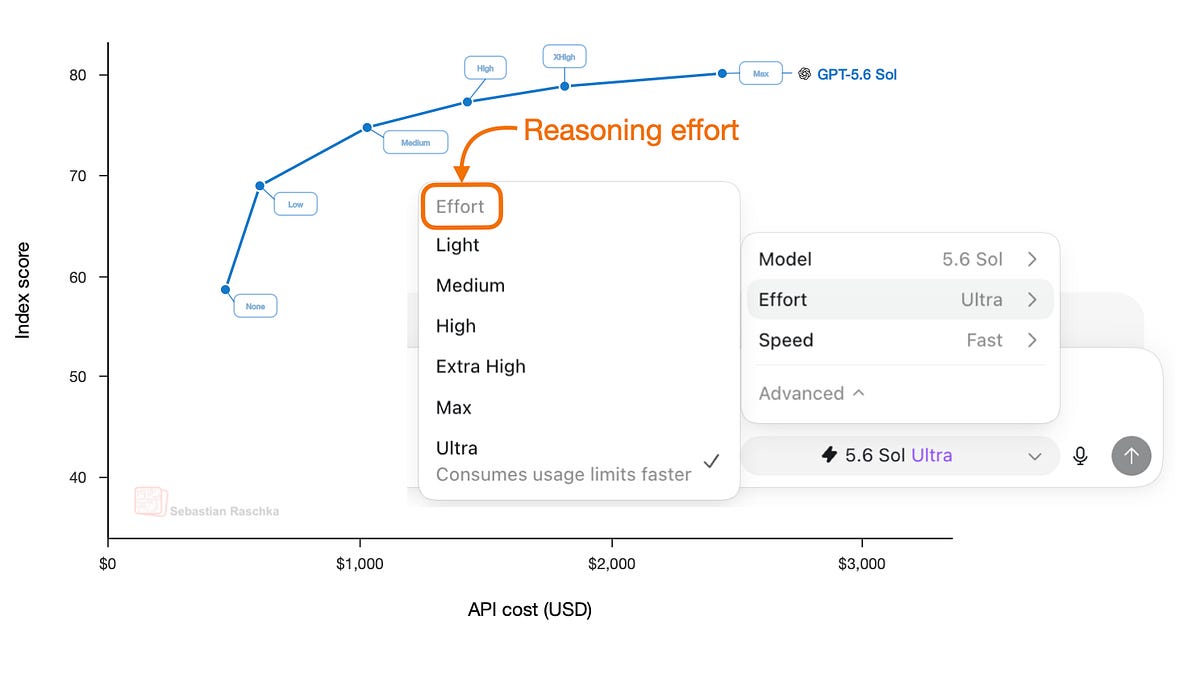
Sebastian Raschka’s latest analysis on Controlling Reasoning Effort in LLMs provides the most actionable framework for engineers currently struggling with the "one-size-fits-all" latency of frontier models. By formalizing how models can be tuned for low-, medium-, and high-effort reasoning modes, this work offers a blueprint for building agentic pipelines that dynamically allocate compute based on task difficulty, directly addressing the cost-latency trade-off in production systems.
📍 In a Nutshell
- Claude Code now runs on a Rust-based Bun — achieving a 10% speedup on Linux by optimizing the underlying runtime.
source
- Smartsheet’s remote MCP server architecture — demonstrates a scalable pattern for deploying Model Context Protocol servers on AWS with robust governance.
source
- ASCIITermDraw-Bench released — a new evaluation suite testing VLM capabilities in generating and editing terminal-based ASCII graphics.
source
- Inkling vs. Qwen3-235B debate — community analysis of the Thinking Machines Tinker result suggests base model selection remains the primary driver of AIME performance over fine-tuning.
- Qwen3 rumors intensify — community speculation on upcoming releases continues to drive high engagement on r/LocalLLaMA.
- AI decision-making critique — Nik Suresh highlights the growing friction between AI-driven automation and traditional corporate decision-making structures.
🚀 Opportunity of the Day2 min read
The single best thing to build right now.
Dynamic Reasoning-Budget Orchestrator (DRBO)
- The gap: Current agentic frameworks treat inference as a static cost; they lack a middleware layer that dynamically adjusts the "reasoning budget" (e.g., chain-of-thought depth, speculative decoding passes) based on real-time task complexity.
- Why now: Raschka’s recent work on controlling reasoning effort, combined with the emergence of high-performance runtimes like the Rust-based Bun, makes it possible to build low-latency control loops that modulate model behavior without significant overhead.
- Build as: A middleware library (Python/Rust) that sits between your application and the LLM API, intercepting requests to inject or prune reasoning tokens based on a lightweight classifier.
- Wedge & moat: The wedge is cost-reduction for high-volume agentic workflows; the moat is the proprietary "complexity-to-budget" mapping dataset you build as users adopt the tool.
- Already heating up: High community interest in "reasoning-trace distillation" and the ongoing debate regarding base model performance vs. inference-time compute (e.g., the Inkling/Tinker discussion). (speculative — no direct product validation yet)
- Closest existing solution: LlamaIndex provides orchestration but lacks native, automated reasoning-budget modulation; the opening is for a specialized "Inference-Ops" layer.
- First step this week: Prototype a "reasoning-budget" wrapper that uses a small, fast model (e.g., Qwen-7B) to classify task complexity and route to either a fast-path or a high-reasoning-path model.
📊 Stack Signals — Pick Your Tools3 min read
What moved in tools, benchmarks & funding.
Benchmarks & Evals
- No material shifts on the
LMSYS Chatbot Arena⚠ in the last 48 hours; the leaderboard remains dominated by the current frontier models.
Repo & Model Velocity
- Bun — continues to see adoption as a high-performance runtime, now powering Claude Code.
- Qwen — remains the primary focus of local-LLM community development and speculation.
Funding & Launches — with Thesis
- Smartsheet (AWS Integration) — Thesis: Enterprise adoption of AI requires robust, remote-first MCP architectures that prioritize security and governance over raw model performance.
🔬 Deep Reads — For When You Have Time (skip if rushed)
The one paper to actually read this week.
📖 The One Deep Read
Controlling Reasoning Effort in LLMs by Sebastian Raschka. This post is essential for understanding how to move beyond static prompting and into the era of inference-time compute management. It bridges the gap between theoretical reasoning research and practical engineering constraints.
Read it for: The taxonomy of reasoning modes and the practical implications for agentic latency.
📑 Supporting Research
Code2LoRA (et al.) — A look at hypernetwork-generated adapters for code models, relevant for specialized agentic tasks.