👋 In Brief30 sec read
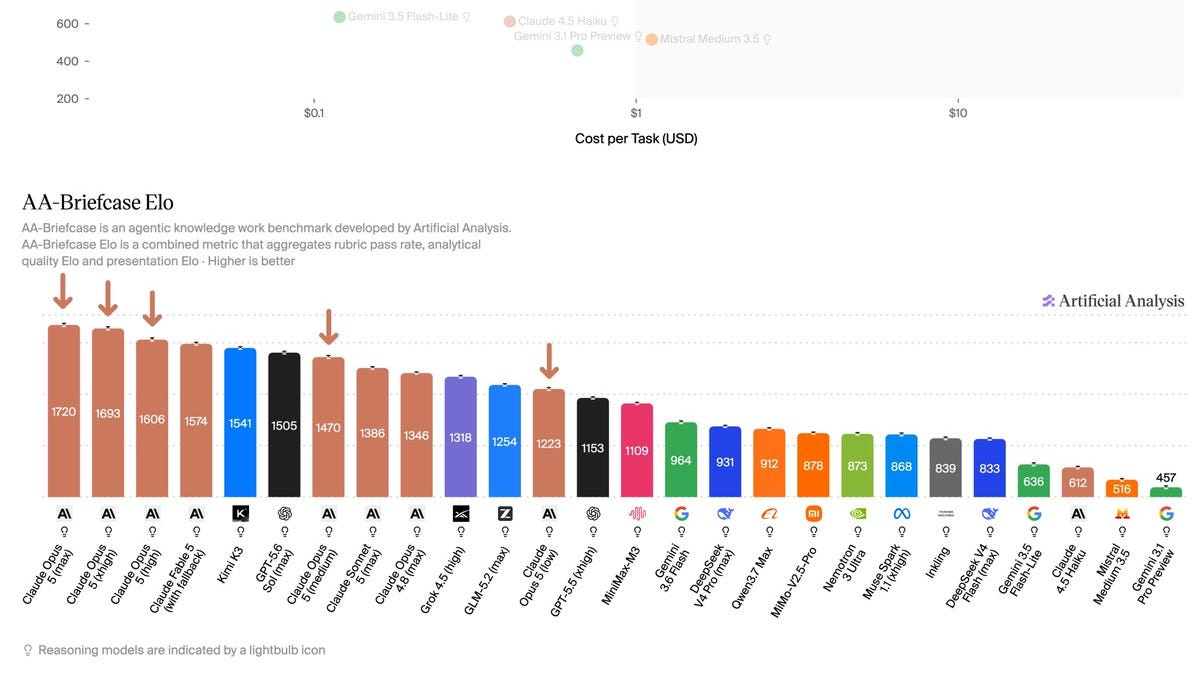
The frontier is shifting from raw capability to hardened, production-ready reliability, headlined by the release of Claude Opus 5. As we move deeper into agentic workflows, the focus is rapidly narrowing on inference-time efficiency and the infrastructure required to support long-context, high-compute reasoning tasks at scale.
📌 Top Stories — Today's Biggest Moves (skim)
The day's highest-signal stories, ranked by builder-relevance — each linked to its primary source.

⚡ The Pulse — If You Only Read One Thing90 sec read
The day's signal in 90 seconds — start here.
🎯 Today's Game-Changer
Anthropic has released 
📍 In a Nutshell
Together AI's DeepSWE analysis shows Kimi K3 delivering 2.8x the solves-per-dollar compared to Claude Fable 5, highlighting a growing divergence between peak capability and cost-efficient coding agents.
NVIDIA ModelExpress launched to optimize the distribution of multi-hundred GB model checkpoints, addressing the massive latency bottleneck in scaling distributed inference clusters.
DKV (DifferentialKV) released as an open-source framework for KV-cache compression, enabling longer context windows on constrained local hardware.
NVIDIA's "Open Weights and American AI Leadership" whitepaper argues for the strategic necessity of open-weight models in maintaining domestic AI competitiveness.
🚀 Opportunity of the Day2 min read
The single best thing to build right now.
Inference-Time Reasoning Orchestrator (IRO)
- The gap: Current agentic frameworks treat reasoning as a monolithic call. Research (e.g.,
Test-Time Scaling via Error Localization) proves that performance scales linearly with compute-per-token, but we lack a middleware that dynamically allocates "thinking time" based on task complexity.
- Why now: The release of Claude Opus 5 provides a high-reasoning baseline, while DKV-style compression allows for the memory overhead required to hold multiple reasoning traces in the KV-cache simultaneously.
- Build as: A Python-based middleware library (OSS) that sits between the LLM API and the agent loop, implementing a "reasoning budget" that triggers iterative error-correction loops only when confidence scores drop.
- Wedge & moat: Start by targeting SWE-bench-style coding agents where "thinking" is expensive; the moat is the proprietary heuristic engine that optimizes the trade-off between latency and pass@1 rates.
- Already heating up: (Speculative — no direct product validation yet, but high interest in "test-time compute" on r/LocalLLaMA and recent arXiv activity).
- Closest existing solution: LlamaIndex handles orchestration but lacks native, budget-aware test-time scaling logic; the opening is for a specialized "reasoning-ops" layer.
- First step this week: Prototype a "Reasoning-Budget" wrapper that forces a model to re-generate reasoning traces if the initial output fails a deterministic unit test, measuring the cost-to-success ratio.
📊 Stack Signals — Pick Your Tools3 min read
What moved in tools, benchmarks & funding.
Benchmarks & Evals
- DeepSWE: Together AI's rollout of 452 tasks shows a 1.4-point pass@1 lead for Claude Fable 5 over Kimi K3, establishing a new baseline for coding agent evaluation.
Repo & Model Velocity
- DKV⚠: Rapidly gaining traction as the first accessible KV-cache compression framework for local inference.
Inflect v2⚠: Trending on Hugging Face for its sub-10M parameter footprint in TTS.
Funding & Launches — with Thesis
Oracle: Massive workforce restructuring to pivot toward AI infrastructure. Thesis: Betting on the "AI-as-a-Utility" model for enterprise cloud dominance.
🔬 Deep Reads — For When You Have Time (skip if rushed)
The one paper to actually read this week.
📖 The One Deep Read
Test-Time Scaling via Error Localization by Chitale and Madhavan. This paper is essential because it moves beyond "more compute = better" and introduces a surgical approach to inference-time scaling by identifying *where* a model fails in its reasoning chain. Read it for: The methodology on how to implement selective re-computation in agentic loops.
📑 Supporting Research