👋 In Brief30 sec read
The industry is shifting from raw model scaling to inference-time optimization and agentic throughput, with new techniques for reasoning budgets and real-time vision-language-action models dominating the discourse. Today’s briefing highlights how frontier labs are unlocking massive performance gains through simple configuration changes and how the infrastructure layer is finally catching up to the latency requirements of embodied AI.
📌 Top Stories — Today's Biggest Moves (skim)
The day's highest-signal stories, ranked by builder-relevance — each linked to its primary source.


⚡ The Pulse — If You Only Read One Thing90 sec read
The day's signal in 90 seconds — start here.
🎯 Today's Game-Changer
OpenAI has tripled their scores on the ARC-AGI-3 benchmark by enabling two specific API settings that optimize reasoning and compaction. This result confirms that frontier intelligence is increasingly gated by inference-time configuration rather than just parameter count, signaling a pivot toward "reasoning-on-demand" architectures where builders can trade latency for significantly higher problem-solving accuracy.
📍 In a Nutshell
TurboVLA enables real-time vision-language-action inference at 32 Hz on an RTX 4090 with <1 GB VRAM, drastically lowering the barrier for embodied robotics.
Together AI's ThunderAgent delivers 2x faster agentic inference by treating workflows as schedulable programs to eliminate KV cache thrashing.
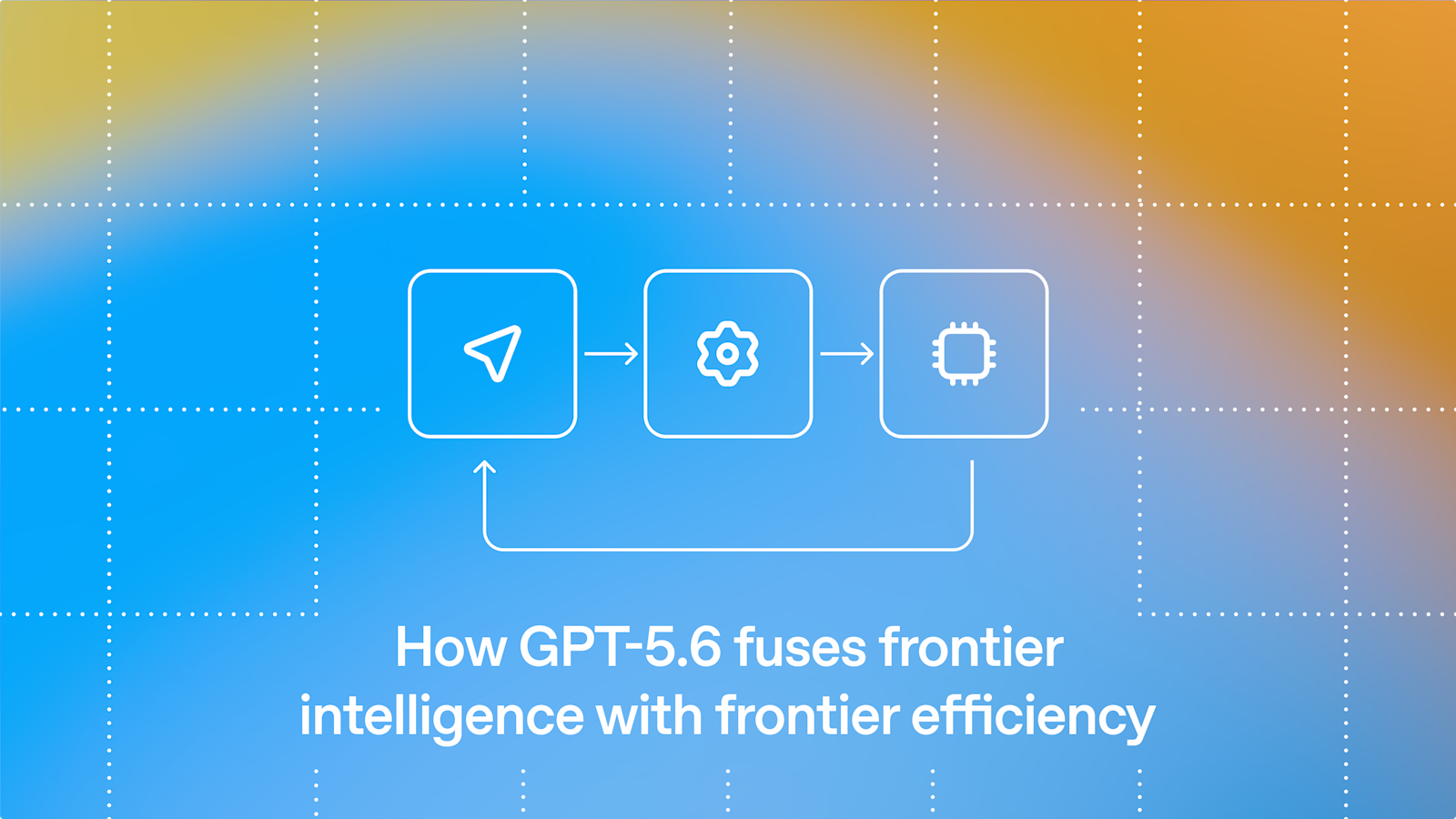
GPT-5.6 is now live, focusing on fusing frontier intelligence with inference-time efficiency to maximize utility per dollar.
Ontologies are returning as a critical tool for AI engineers to constrain probabilistic agents within deterministic, business-logic boundaries.
New prompt injection variants in Microsoft Word demonstrate self-replicating worm capabilities, highlighting a major security gap in document-based agent workflows.
MindControl for llama.cpp introduces sampler-level guided reasoning budgets, allowing developers to nudge models based on their own internal thinking budget.
Research transparency is declining as top AI startups move toward closed-source models, creating a "black box" ecosystem that complicates independent safety auditing.
AWS Bedrock AgentCore now supports MCP server connectors for autonomous, cross-system business intelligence without custom code.
🚀 Opportunity of the Day2 min read
The single best thing to build right now.
VLA-Action Latency Optimizer
- The gap: While
- Why now: The convergence of
- Build as: A dev tool / middleware library that acts as a "jitter buffer" for VLA models, ensuring smooth motor control commands even when the underlying LLM inference latency spikes.
- Wedge & moat: The wedge is a drop-in Python library for ROS2 (Robot Operating System) users; the moat is the proprietary scheduling algorithm that predicts VLM latency based on visual scene complexity.
- Already heating up: 109 upvotes on HF Daily Papers for TurboVLA and active discussion on r/LocalLLaMA regarding local research tools; clear demand for "fast" local embodied agents.
- Closest existing solution: LlamaIndex handles data orchestration, but lacks the real-time, sub-millisecond scheduling required for physical-world action policies.
- First step this week: Prototype a "latency-aware" action scheduler that wraps a VLA model and benchmarks command-stream stability against a standard non-buffered implementation.
📊 Stack Signals — Pick Your Tools3 min read
What moved in tools, benchmarks & funding.
Benchmarks & Evals
- ARC-AGI-3: OpenAI reports a 3x score increase via new API settings, establishing this as the primary benchmark for reasoning-time compute efficiency.
- OmegaUse-OfficeVal: A new benchmark for long-horizon office-suite tasks with economic grounding, highlighting the need for cost-aware agent evaluation.
source
Repo & Model Velocity
Funding & Launches — with Thesis
🔬 Deep Reads — For When You Have Time (skip if rushed)
The one paper to actually read this week.
📖 The One Deep Read
Can AI agents conduct open-ended AI research? by Kirgis et al. This paper provides the first rigorous look at whether agents can move beyond narrow tasks into actual scientific discovery. It is essential reading because it challenges the "explosive progress" narrative by identifying the specific bottlenecks in open-ended agentic research. Read it for: A reality check on the current limitations of autonomous research agents.
📑 Supporting Research