👋 In Brief30 sec read
The industry is grappling with a critical security vulnerability: the leakage of proprietary reasoning traces from LLM APIs, which threatens the intellectual property of agentic workflows. Simultaneously, we are seeing a massive leap in 4D world generation and specialized medical AI, signaling that the next frontier is not just text, but high-fidelity, temporal, and clinical reasoning.
📌 Top Stories — Today's Biggest Moves (skim)
The day's highest-signal stories, ranked by builder-relevance — each linked to its primary source.

⚡ The Pulse — If You Only Read One Thing90 sec read
The day's signal in 90 seconds — start here.
🎯 Today's Game-Changer
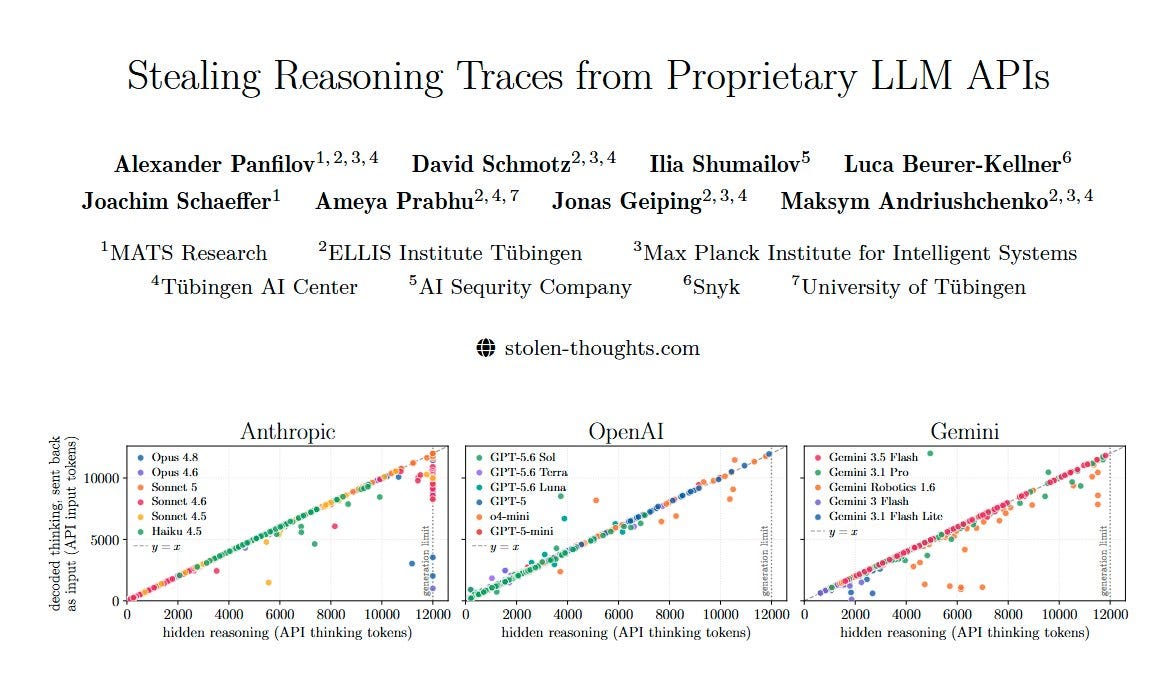
The discovery that proprietary LLM APIs from Anthropic, OpenAI, and Google return encrypted or raw chain-of-thought (CoT) blocks that can be replayed or distilled across sessions has created a major security exposure for enterprise platforms. As detailed in the Latent Space analysis and the
stolen-thoughts.com research, this "reasoning trace theft" allows third parties to reverse-engineer proprietary reasoning strategies. For architects, this necessitates an immediate review of how reasoning traces are handled, cached, and exposed in your API response pipelines.
📍 In a Nutshell
- Google Research unveils
AMIE — a medical AI system capable of real-time clinical video consultation.
- Microsoft introduces
CARE-X — a unified VLM approach for radiology that integrates tool-augmented measurement for chest X-rays.
- OpenAI and AWS launch
Daybreak Red/Blue — specialized cybersecurity models now available on Amazon Bedrock.
- Qwen releases new models — the community is tracking the
latest Qwen iteration for potential frontier-level performance.
- NVIDIA updates
JetPack 7.2.1 — adding agentic video skills and T3000 emulation for edge robotics.
- Meta's
Muse Glimmer — the chat template has been updated, signaling ongoing refinement of this orchestrator model.
- Chai Discovery closes
four pharma deals — highlighting a major shift in BioAI commercialization.
- llama.cpp — now supports faster inference on Apple Silicon via macOS VM GPU passthrough.
🚀 Opportunity of the Day2 min read
The single best thing to build right now.
Reasoning-Trace Obfuscation & Sanitization Proxy (RT-OSP)
- The gap: Current LLM API responses often include raw or semi-structured reasoning traces that leak proprietary logic, as highlighted by the
stolen-thoughts.com findings.
- Why now: The recent exposure of reasoning-trace replayability makes this a "must-have" for enterprise security compliance, moving from a niche concern to a CISO-level requirement.
- Build as: A high-performance middleware proxy (Go or Rust) that sits between the LLM provider and the application, stripping or encrypting CoT blocks before they reach the client.
- Wedge & moat: The wedge is a "Security-First LLM Gateway" that guarantees trace-privacy; the moat is the proprietary sanitization logic that preserves model performance while removing sensitive reasoning metadata.
- Already heating up: Significant discourse on
HN and
- Closest existing solution: Standard API gateways (e.g., Kong, Apigee) lack LLM-specific semantic awareness for CoT blocks; there is no dedicated "Reasoning-Trace Firewall."
- First step this week: Prototype a middleware that intercepts OpenAI/Anthropic responses, identifies the CoT block via regex/schema-matching, and replaces it with a placeholder or encrypted token.
📊 Stack Signals — Pick Your Tools3 min read
What moved in tools, benchmarks & funding.
🧱 Standards, Protocols & the Agent Platform Stack
- macOS GPU Passthrough [Serving/Infra] — Architect's take: Prototype for local-first agentic inference on Apple Silicon.
- MCP (Model Context Protocol) [Memory/Context] — Architect's take: Continue monitoring for registry updates; it remains the primary candidate for standardized tool-calling.
Benchmarks & Evals
- No material leaderboard shifts in the last 48 hours; the industry is awaiting the impact of the new Qwen model on the
LMSYS Arena⚠.
Repo & Model Velocity
- cua — Trending for its work on macOS GPU passthrough.
Funding & Launches — with Thesis
Suzanne — AI tool for physical product manufacturing. Thesis: Vertical AI agents for CAD/CAM workflows are the next frontier for industrial automation.
🔬 Deep Reads — For When You Have Time (skip if rushed)
The one paper to actually read this week.
📖 The One Deep Read
Long-Horizon AI Research for Grothendieck Constant by Li et al. This paper provides a masterclass in human-AI collaboration for high-level mathematics. It is essential reading for understanding how to structure long-horizon agentic tasks that require iterative verification and deep reasoning.
Read it for: A blueprint on how to manage multi-step, high-stakes agentic reasoning.
📑 Supporting Research
Surgical WAM — Data-efficient learning for surgical robotics.