| Friday, September 4, 2026 |
👋 In Brief30 sec read
The release of GPT-6 Astra has effectively reset the baseline for agentic capability, shifting the focus from simple chat to autonomous, multi-step computer use. Today’s briefing tracks how this new frontier model is already being integrated into enterprise workflows and the emerging standards for agentic interoperability that will define the next six months.
📌 Top Stories — Today's Biggest Moves (skim)
The day's highest-signal stories, ranked by builder-relevance — each linked to its primary source.


⚡ The Pulse — If You Only Read One Thing90 sec read
The day's signal in 90 seconds — start here.
🎯 Today's Game-Changer
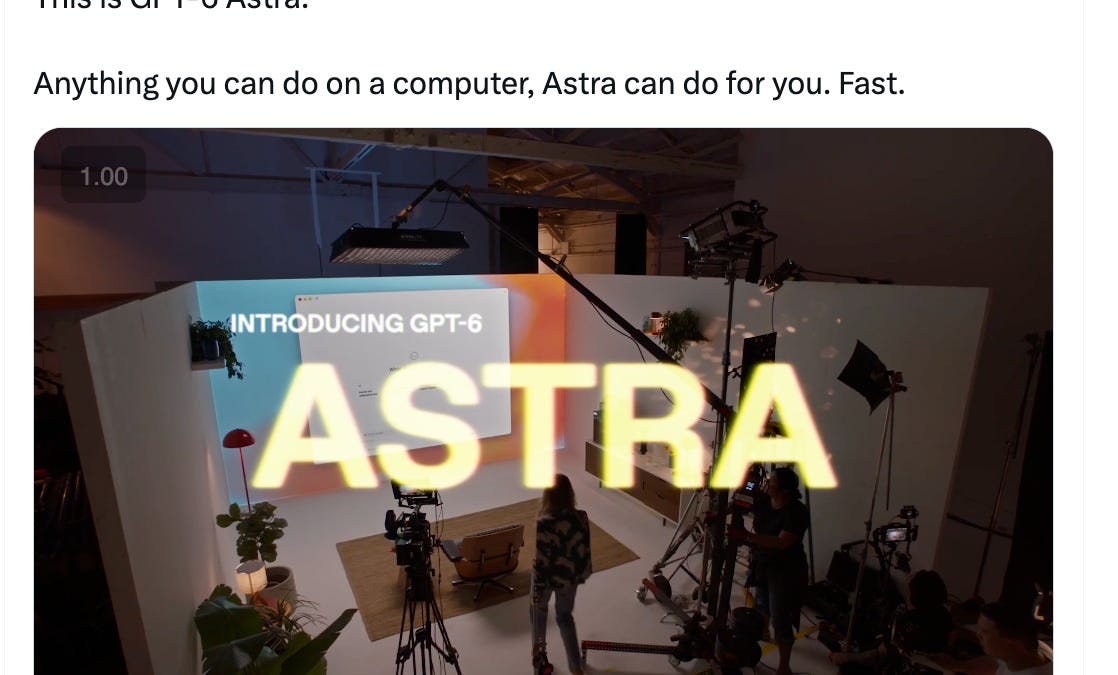
OpenAI has released GPT-6 Astra, a frontier model class that sets a new SOTA for computer use and autonomous coding tasks. Early reports indicate it achieves a 50% reduction in manual fixes for game prototyping and a 40% performance gain in complex financial document review, signaling a transition from "chat-based" AI to "agentic-execution" AI that can reliably navigate UI and multi-document environments.
Latent Space notes that while token costs are 2.5x higher, the task-level efficiency makes it significantly cheaper for production agentic workflows.
📍 In a Nutshell
The Natural Language Interaction Protocol proposes a new standard for agent-to-agent (A2A) communication across heterogeneous frameworks.
Amazon Bedrock AgentCore launches to standardize the AI-driven development lifecycle (AI-DLC) for enterprise production.
Paddock, a high-performance Rust/C++ inference engine with custom CUDA kernels, is now open-source (MIT/Apache-2.0).
LLaDA-Image introduces a 6B Diffusion Transformer trained from scratch, offering a fully open recipe for image generation.
NVIDIA PAIR virtual inference router enables local network compute distribution for multi-agent systems.
OpenAI Daybreak commits $1B to provide frontier cyber AI access to essential services and critical infrastructure.
🚀 Opportunity of the Day2 min read
The single best thing to build right now.
Agentic-Review Acceptance Engine (ARAE)
- The gap: Current coding agents (like those in SWE-bench) optimize for passing functional tests, but as noted in
- Why now: GPT-6 Astra’s improved reasoning and document-review capabilities (40% improvement in financial review) make it the first model capable of acting as a "Senior Reviewer" that understands style guides, architectural constraints, and maintainability.
- Build as: A CI/CD integration tool that acts as an automated "Reviewer Agent" sitting between the coding agent and the human merge button.
- Wedge & moat: The wedge is a GitHub App that provides "Reviewer-as-a-Service" for existing agentic coding workflows; the moat is the proprietary dataset of "rejected vs. accepted" agent-generated PRs.
- Already heating up: (Speculative — no direct product yet, but the
- Closest existing solution: Codium PR-Agent exists, but it is primarily a helper; an ARAE would be a gatekeeper that enforces architectural compliance, not just bug detection.
- First step this week: Build a prototype that takes a PR from a standard coding agent (e.g., OpenDevin) and evaluates it against a set of "Senior Engineer" personas using GPT-6 Astra.
📊 Stack Signals — Pick Your Tools3 min read
What moved in tools, benchmarks & funding.
🧱 Standards, Protocols & the Agent Platform Stack
Benchmarks & Evals
Repo & Model Velocity
- Paddock⚠: High-performance Rust/C++ inference engine; gaining rapid traction for local deployment.
Funding & Launches — with Thesis
🔬 Deep Reads — For When You Have Time (skip if rushed)
The one paper to actually read this week.
📖 The One Deep Read
The Natural Language Interaction Protocol and Standard for AI Agents by Luyi Xing and Rasit Onur Topaloglu. This paper addresses the fragmentation of agentic frameworks by proposing a universal protocol for agent interoperability. It is essential reading for architects building multi-agent systems that need to scale across different model providers and toolsets. Read it for: The proposed standard for agent-to-agent message passing.
📑 Supporting Research