| Tuesday, September 8, 2026 |

👋 In Brief30 sec read
The agentic stack is shifting from simple tool-calling to "Agentic Engine Optimization" (AEO), where the battle for visibility is no longer about human search intent but about how frontier models prioritize your data. Simultaneously, the infrastructure layer is finally bridging the gap between high-level agentic logic and low-level hardware performance with the arrival of native Rust support for GPU kernels.
📌 Top Stories — Today's Biggest Moves (skim)
The day's highest-signal stories, ranked by builder-relevance — each linked to its primary source.



⚡ The Pulse — If You Only Read One Thing90 sec read
The day's signal in 90 seconds — start here.
🎯 Today's Game-Changer
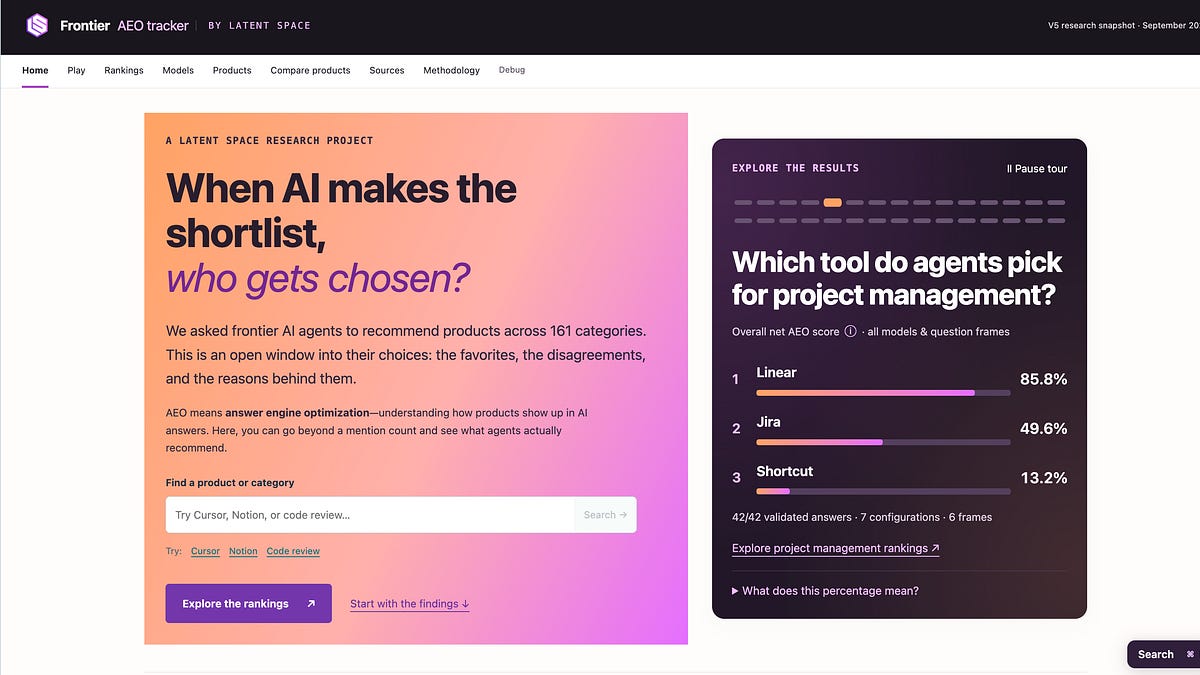
The Frontier AEO Tracker by Latent Space has officially codified "Agentic Engine Optimization" (AEO) as the new critical layer for platform owners. By analyzing what frontier models (like Astra) choose when navigating the web, this tracker exposes the hidden heuristics models use to prioritize information, effectively creating a new "SEO" for the agentic era. For architects, this is the signal that your platform's data-ingestion strategy must now account for model-specific retrieval biases rather than just standard keyword relevance.
📍 In a Nutshell
- NVIDIA releases
CUDA Rust — enabling native, memory-safe GPU kernel development for high-performance agentic backends.
- DeepSeek Flash 4.1
enters beta — featuring a new architecture with native multimodal support and significantly reduced inference latency.
- Google DeepMind unveils
AlphaGenome Atlas — a massive predictive map of 9 billion DNA variants, showcasing the next frontier of biological agentic research.
- Simon Willison updates
llm 0.35 — adding support for the new gpt-6-astra model, essential for testing agentic workflows.
- OpenAI publishes
The Work Now Within Reach — a strategic look at how falling compute costs are enabling new classes of autonomous enterprise agents.
- Claude achieves
Fermat's Last Theorem proof — demonstrating a significant leap in long-chain reasoning capabilities.
- Gradient Flow explores
self-improving AI — detailing the transition from static interactions to continuous, post-deployment learning loops.
- Linux kernel maintainers report
- MiniMax H3
🚀 Opportunity of the Day2 min read
The single best thing to build right now.
AEO-Observability & Attribution Middleware
- The gap: As agents increasingly act as the primary interface for users, there is zero visibility into *why* an agent chose a specific tool or data source over another. The
Frontier AEO Tracker proves that models have distinct "preferences," but developers have no way to audit or optimize their content for these agentic pathways.
- Why now: With the rise of "Astra" and other agentic-first models, the "Agentic Engine" is becoming the new browser. We are at the same stage as 1998 search engines: the traffic is shifting, but the analytics tools are non-existent.
- Build as: A SaaS platform that provides "Agentic Attribution" — tracking which data sources, docs, or API endpoints are being "clicked" or "referenced" by specific agent models during their reasoning traces.
- Wedge & moat: Start by offering a "Model-Specific SEO Audit" for enterprise documentation sites. The moat is the proprietary dataset of agent-trajectories you collect, which becomes the training data for future AEO-optimization models.
- Already heating up: (speculative — no direct commercial product yet, but high interest in the
- Closest existing solution: Traditional web analytics (Google Analytics, Mixpanel) — these fail because they track human clicks, not the semantic "reasoning-trace" selections made by LLMs.
- First step this week: Build a simple proxy that logs the `User-Agent` and `Reasoning-Trace` metadata for incoming requests from known agentic platforms (OpenAI, Anthropic, Google) to identify which content is being prioritized.
📊 Stack Signals — Pick Your Tools3 min read
What moved in tools, benchmarks & funding.
🧱 Standards, Protocols & the Agent Platform Stack
Benchmarks & Evals
- LMSYS Arena: No major leaderboard shifts in the last 48 hours, but the community is actively testing
Repo & Model Velocity
- CUDA Rust⚠ — Rapidly gaining traction as the standard for memory-safe GPU programming.
DeepSeek Flash 4.1 — Trending on HF as developers scramble to test the new multimodal architecture.
Funding & Launches — with Thesis
🔬 Deep Reads — For When You Have Time (skip if rushed)
The one paper to actually read this week.
📖 The One Deep Read
The Work Now Within Reach (OpenAI). This essay is the definitive strategic roadmap for the next 12 months of agentic adoption. It moves beyond the "AI is a chatbot" narrative and frames AI as a fundamental economic lever for growth. Read it for: Understanding the specific business use cases OpenAI is prioritizing for the next wave of agentic deployment.
📑 Supporting Research